Twenty easy things to draw
Pick one idea and give yourself a small boundary: ten minutes, one page corner, or three values. A limit turns a vague intention into an approachable exercise.
Around the home
Household objects have stable proportions and useful edges, which makes them ideal for practicing observation without pressure.
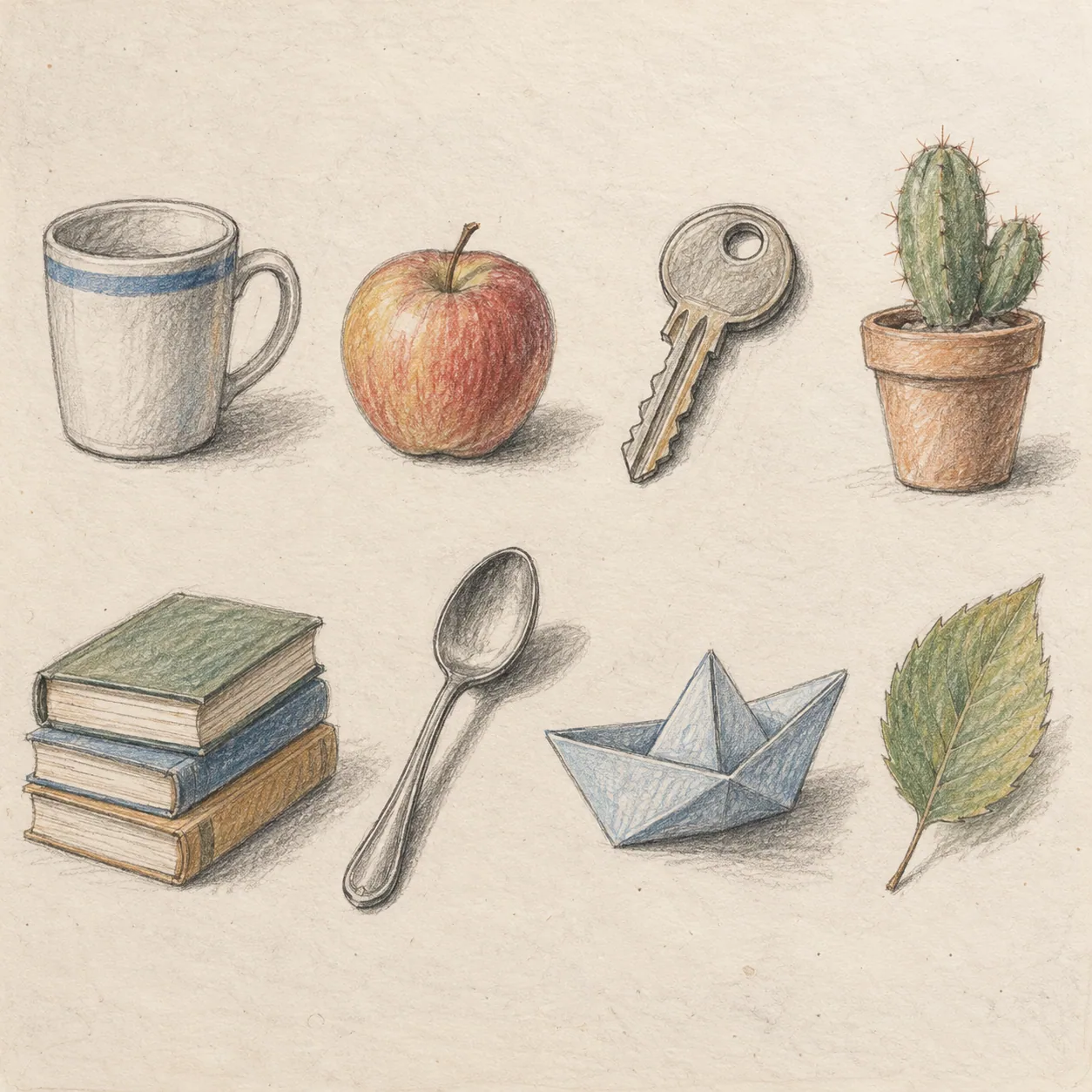
A simple ceramic mug
Start with the rim ellipse, add two sides that narrow toward the base, and use the handle as a separate curved shape.
A desk lamp
Break the lamp into a shade, stem, and base. The angle of the shade gives the whole drawing a clear direction.
A pair of folded glasses
Use two rounded frames and a bridge, then let the folded arms create a small overlap. Keep the lenses mostly empty.
A houseplant by a window
Draw a pot, three leaf shapes, and one simple window rectangle. The repeated leaves make a satisfying beginner pattern.
A stack of three books
Use offset rectangles and a soft cast shadow. Vary the thickness so the stack feels handled rather than mechanically perfect.
Simple food shapes
Food offers clear contours and small texture choices. Draw the main mass first, then add only the marks that explain its surface.
An apple on a plate
Build the apple from two joined curves, add a short stem, and use the plate ellipse to practice a light perspective.
A lemon cut in half
Draw the outer oval and divide the cut face into a few wedges. The center pattern gives the sketch a natural focal point.
A small bowl of rice
Use a wide bowl ellipse and a loose mound of rice. A few curved grain groups suggest texture without outlining every grain.
A spoon beside a napkin
The spoon is a long capsule with one highlight; the napkin adds simple folded angles and a soft contrast in texture.
A loaf of bread
Draw a rounded loaf with a few diagonal cuts. A darker underside and one broken contour make it feel warm and tangible.
Leaves, stones, and weather
Natural forms do not require perfect geometry. Their small irregularities are useful practice for line confidence and value.
A single leaf
Mark the central vein, taper both ends, and let one edge wobble gently. Add two side veins on the shadow side.
A smooth river stone
Use one irregular oval and a soft shadow beneath it. A narrow highlight can explain the stone's rounded surface.
A cloud over a field
Draw one cloud mass and one low horizon. Two value groups are enough to make a quiet landscape study.
A pinecone
Start with the overall cone silhouette, then add overlapping scale rows that become smaller toward the tip.
A puddle after rain
Use a broken horizontal oval and a few reflected lines. The empty center can stay light to suggest a wet surface.
Small adventures
A tiny scene gives a simple object somewhere to go. Keep the background spare and let one diagonal create movement.
A paper boat on a stream
Fold the boat into a few clear planes, then place it on two long water lines. One small flag can personalize it.
A bicycle leaning on a wall
Use two circles for wheels and a triangular frame. Let the wall remain a single quiet plane behind it.
A suitcase ready to travel
Draw a box with a handle, two wheels, and one luggage tag. The angle of the case suggests destination without a detailed scene.
A tent under the moon
Use a triangle, two ground lines, and a small moon. Keep the opening dark so the simple silhouette feels inviting.
A lantern on a path
Build the lantern from a box and handle, then place it beside a path that narrows into the distance.
A simple way to finish an easy drawing
Limit yourself to three decisions after the first outline: one important shadow, one texture, and one grounding mark. For a mug that might be the underside, a small highlight, and a table shadow. This keeps the drawing complete without turning a ten-minute exercise into a technical project.
If the subject feels too ordinary, change the viewpoint rather than adding decoration. Draw the mug from above, put the apple near the edge of the plate, or let the paper boat face toward the viewer. A small change in angle gives an easy drawing a fresh problem to solve.