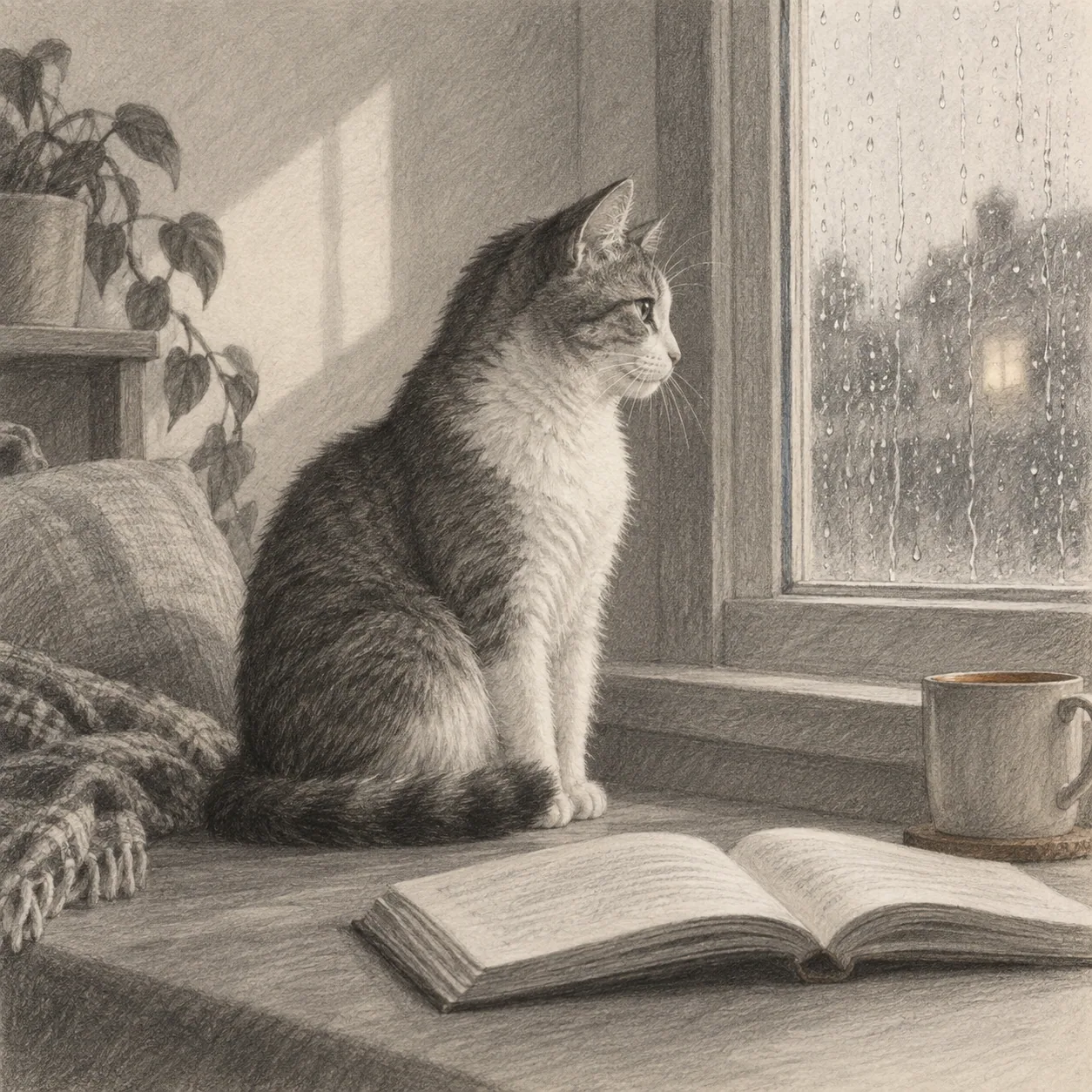
A cat reading beside a rainy window, framed by a quiet room and one bright reflection.
Focus
Silhouette and reflected light
Constraint
Use three values and one warm detail
Draw this suggestion in three moves
Try one of these related drawing suggestions, or browse more drawing suggestions below.
Use randomness to choose, then make it yours
Random drawing suggestions are useful when too much choice is slowing you down. The surprise gives you a constraint, and the way you respond becomes the creative part.
Why random suggestions help
Choosing a subject can take more energy than drawing it. A random suggestion removes that first decision and gives you something concrete to observe, imagine, or transform.
You do not have to like the suggestion immediately. Give it two minutes. Often the interesting idea appears after you stop judging the subject and start asking what it could become.
Add a simple rule
Pair a random suggestion with one limitation: use only straight lines, draw from memory, work in a square, or stop after fifteen minutes. The rule keeps the exercise focused without turning it into a performance.
Notice what the limitation changes. A time limit may make your gesture clearer. A restricted palette may make you pay attention to value. The exercise is as much about noticing as it is about the final picture.
Turn random sketches into a series
Save the results and look for recurring shapes, moods, or subjects. A random collection can reveal a visual interest you would not have chosen deliberately.
When one suggestion stays with you, return to it later and make a second version with a different viewpoint or medium. Chance can open the door; repetition gives the idea depth.
Keep a record of what chance reveals
Write down the subject, time limit, and first reaction beside each drawing. The note does not need to be a review. It can be as simple as the shadow was more interesting than the object or I wanted to move the viewpoint closer. These observations turn random drawing suggestions into a record of your attention. After several sessions, look for patterns in the choices you make after the random starting point arrives.
A useful series can keep one element constant while everything else changes. Use the same paper, the same three values, or the same square frame for a week. The fixed rule gives the drawings a relationship, while the random suggestion keeps each page open. If one subject feels promising, make a deliberate follow-up instead of waiting for chance to return to it. The best result of a random exercise is often a question worth carrying into the next drawing.
Use variations to find the idea inside the idea
When a random subject seems ordinary, change the way you approach it before you reject it. Draw it from above, reduce it to three values, or place it beside a shape that changes its scale. You can also switch from observation to memory and compare what your mind keeps with what your eyes noticed. Each variation asks a different question while keeping the useful surprise intact. Try changing the tool as well: a blunt pencil, a brush pen, or a single digital layer can reveal different kinds of structure.
Make a row of small thumbnails rather than one ambitious composition. Circle the version with the clearest movement or strongest contrast, then give that one a longer session. This keeps random drawing suggestions playful and prevents a weak first reaction from deciding the whole exercise. Chance supplies the opening; your sequence of choices is where the personal image begins to appear. Keep the discarded thumbnails nearby too: they often contain a useful crop, shape, or shadow that can become the next suggestion.
Questions about random drawing ideas
Random mode is meant to reduce the first decision, not to remove your judgment. Use the surprise as material and decide what deserves more attention.
What is random drawing suggestion mode for?
It gives you a subject when the blank page has too many possible starting points. The result is a human drawing suggestion, not a finished assignment; you can interpret it, edit it, or use it to start a series.
Can I reject a random suggestion?
Yes. Give it a brief attempt to see whether a useful question appears, then move on if it does not. The purpose is to interrupt indecision, not to force you to draw a subject that feels uninteresting.
What kind of constraint should I add?
Choose one limit that makes the next action obvious: five minutes, three values, a square frame, one continuous line, or a viewpoint from above. Keep the constraint small enough that it supports curiosity instead of adding pressure.
Should I keep a drawing that does not look finished?
Keep it when it contains a useful observation or question. Date the page and note what held your attention. A rough drawing can show the next experiment more clearly than a polished drawing that taught you nothing new.
How do I continue after the first random sketch?
Change one variable: crop, light, material, scale, or setting. Make a few small thumbnails and choose the one with the clearest movement or strongest relationship for a longer study.