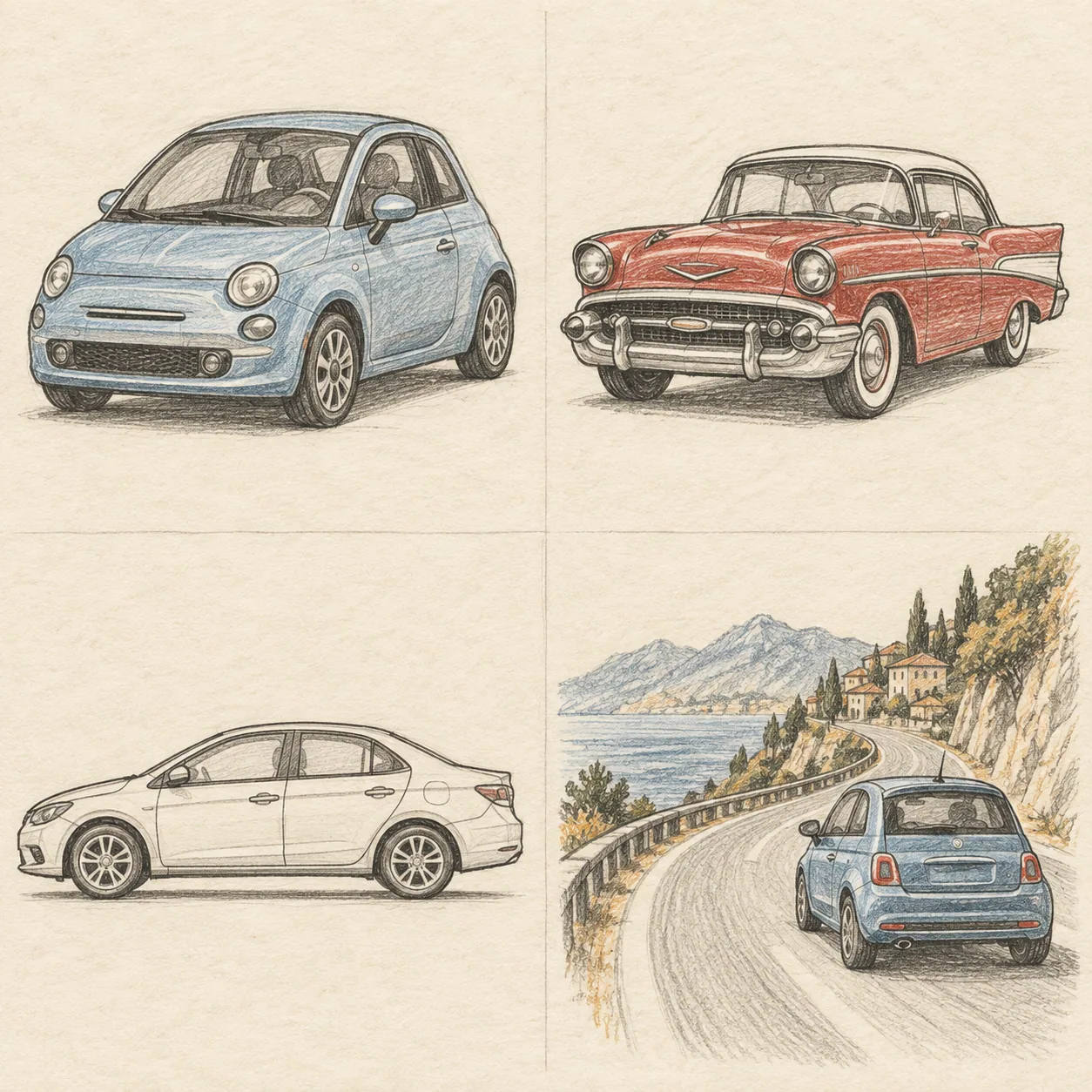
Four ways to explore Car drawing
The sections below are short starting points rather than one fixed lesson. Try the large shape first, then borrow one detail from another version when you want the drawing to feel more specific.
- 01
A friendly, simplified Car
Start with the boxy perspective and the line joining the two wheels. Reduce the subject to two or three rounded or angular masses, then keep the expression or main feature clear enough to read from a distance. This approach is useful when you want a quick sketch, a small icon, or a drawing that leaves plenty of open paper.
Short prompt: place the roofline, wheel ellipses, window blocks, and a simple highlight with one confident contour and stop before decoration takes over.
- 02
A strong Car silhouette
Use a side-view car, a three-quarter parked car, or a compact moving shape as a silhouette study. First block in the outside edge and the most important negative spaces; only after the pose reads should you add interior lines. A clear silhouette makes the subject recognizable even when you use very little shading.
Check the empty shapes around the subject, especially near the boxy perspective and the line joining the two wheels, before adding texture.
- 03
A Car with a sense of movement
Let the drawing travel through a quiet street, a garage opening, or a clean object study. A slight lean, turn, overlap, or change of scale can make the subject feel observed rather than posed. Keep the main gesture loose, then anchor it with one grounded shadow or contact point.
Use a side-view car, a three-quarter parked car, or a compact moving shape to suggest action, and reserve the darkest line for the place where the form carries weight.
- 04
A close study of Car details
Finish with a closer view built around selective reflections and tire shadows without rendering every surface. Do not render every surface equally: choose one or two places where the material changes, and let the rest stay quiet. This contrast helps the eye understand what makes the subject itself.
Add the roofline, wheel ellipses, window blocks, and a simple highlight only after the big shape is stable, then soften one edge so the study keeps its handmade feeling.
How to make a Car drawing feel like yours
Compare the four directions by asking one practical question: which version makes the first mark easiest? You might prefer the broad gesture of a side-view car, a three-quarter parked car, or a compact moving shape, the clear structure of the boxy perspective and the line joining the two wheels, or the close observation of selective reflections and tire shadows without rendering every surface. Start there instead of trying to combine every idea at once. A drawing becomes more personal when you choose what to leave out as carefully as what to include.
Keep the reference visible, but treat it as information rather than a finish line. Change the angle, simplify the background, or move the subject into a quiet street, a garage opening, or a clean object study. If the drawing begins to feel crowded, erase a few interior marks and let the silhouette carry more of the explanation.
If you want to build {pairKeyword} one deliberate decision at a time, continue to the companion tutorial for materials, construction shapes, and a complete finish.
{pairKeyword}