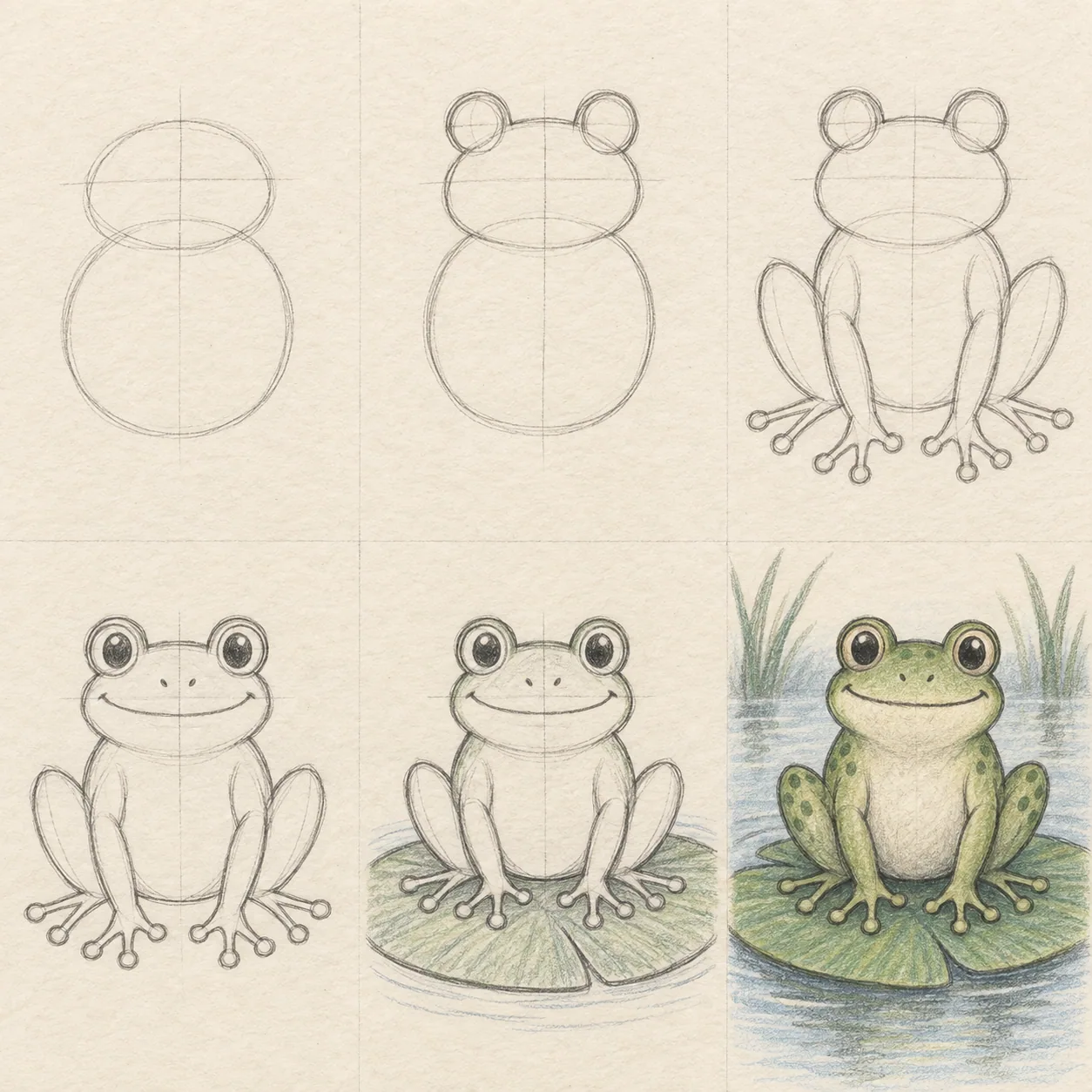
Six steps for drawing a frog
Pause after every large decision and compare the drawing with the reference. If a proportion is wrong, correct the light shape before adding another layer of detail.
- 01
Establish the largest gesture
Begin with a light line that describes the subject's direction, then place the largest mass around it. For Frog, pay special attention to the compact body and the spring-like bend of the legs; this is the decision that controls the rest of the page. Keep the shape loose and leave a margin around it so you can adjust the pose without crowding the paper.
- 02
Place the main landmarks
Add a center line, a cross-axis, or a simple set of guide points to locate the features that organize the form. Check the high eyes, folded hind legs, and the broad mouth line against the larger mass before darkening anything. These landmarks do not need to remain in the final drawing; they are there to keep the parts in the same visual world.
- 03
Build the recognizable structure
Turn the first mass into the subject's characteristic planes, curves, or overlaps. Use a frog sitting low, preparing to leap, or resting beside a leaf to decide where the form bends or carries weight, and compare the negative spaces around it. The drawing should already read as Frog before you add texture or decoration.
- 04
Add the secondary forms
Place the smaller forms that explain how the subject rests, moves, or connects: limbs, leaves, fins, windows, folds, or supporting shapes. Keep them subordinate to the main silhouette. If you are drawing a frog, let the secondary forms support the compact body and the spring-like bend of the legs instead of competing with it.
- 05
Refine the features that matter
Now choose a few specific features from small irregular skin marks kept sparse so the round form stays readable. Vary line weight where the form turns toward shadow, where one shape overlaps another, or where the material changes. You do not need to describe every surface; a small number of well-placed accents will make the subject feel observed.
- 06
Finish with value and one grounded shadow
Erase the construction marks that no longer help, reinforce only the most important contour, and add a restrained value range. A soft shadow beneath the subject or inside its deepest overlap gives the drawing a place to sit. Leave some paper quiet so the high eyes, folded hind legs, and the broad mouth line remains visible instead of getting lost in uniform shading.
Tips for a more convincing Frog drawing
Proportion improves when you compare relationships instead of measuring every isolated part. Look at the distance between the compact body and the spring-like bend of the legs, the scale of the high eyes, folded hind legs, and the broad mouth line, and the amount of space around the pose. If the drawing feels stiff, redraw the gesture from a frog sitting low, preparing to leap, or resting beside a leaf with a lighter hand before repairing the contour.
Use texture as evidence, not wallpaper. A few marks that follow small irregular skin marks kept sparse so the round form stays readable will explain more than an even field of lines. Keep the light coming from one direction, soften the far edges, and reserve the darkest value for the overlap or contact point that needs the most clarity.
Three ways to practice Frog
Repeat the same construction while changing one variable. This makes it easier to see which decision changes the character of the drawing.
- Change the viewpoint while keeping the compact body and the spring-like bend of the legs in the same proportion, then compare the new negative spaces.
- Move a frog into a pond edge, a lily pad, or a damp garden corner and use one simple environmental shadow to connect the forms.
- Simplify the finish to the high eyes, folded hind legs, and the broad mouth line and one strong outer contour for a small, readable thumbnail.
A short practice that builds control
Make three quick thumbnails of a frog. In the first, draw only the gesture and largest mass. In the second, add the landmarks. In the third, keep the same structure and choose one accent from small irregular skin marks kept sparse so the round form stays readable. The exercise separates decisions that are usually tangled together and gives you a clear comparison before a longer study.
Before starting the final attempt, look away from the page and describe Frog in one sentence: its direction, its largest shape, and the feature that makes it recognizable. That sentence becomes a useful filter. If a mark does not support the gesture, structure, or the high eyes, folded hind legs, and the broad mouth line, it can probably wait.